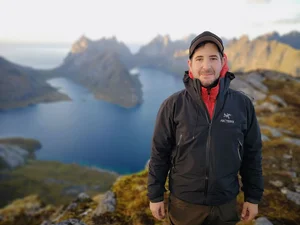
Best Winter Photography Locations on the Lofoten Islands
The Lofoten islands are, in my opinion, among the finest locations for winter photography anywhere on the planet — and a quick Google image search will tell you I'm not alone in that. This archipelago in northern Norway has become one of the absolute top landscape photography destinations in the world, in every season. But winter is the one where the most extraordinary settings happen — and not only because of the elusive Aurora borealis. It's the epitome of the beauty of winter that awaits you.
I've been shooting landscape photography on Lofoten every winter since 2012. Over all those trips, I've met countless people who arrived with the wrong expectations, underprepared for what was waiting — and left without the images they'd dreamed of. This guide is built to make sure that doesn't happen to you. It covers two things: where to shoot (a curated list of the best winter-friendly locations) and how to actually run the trip so you come home with the photographs — clothing, accommodation, timing, driving, and how I keep a 100% aurora score on my trips.
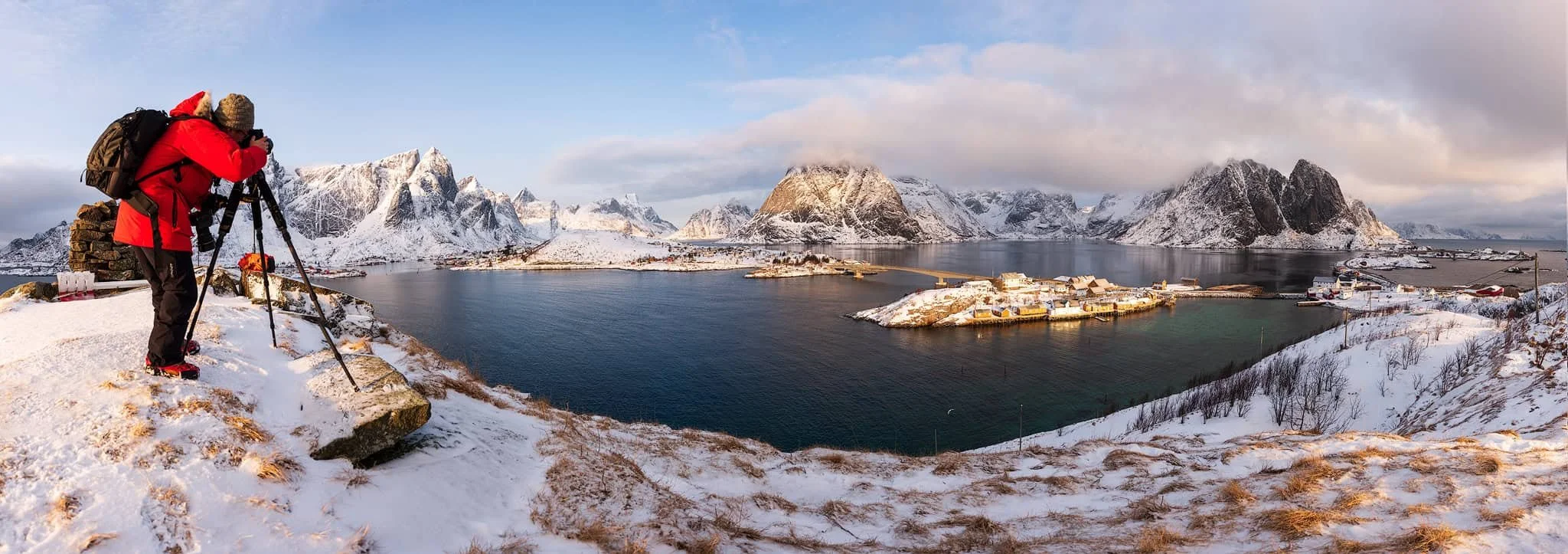
Part 1 — The best winter photography locations in Lofoten
Lofoten in winter isn't about chasing every hidden spot. It's about working with what the season gives us: short days, fast-changing weather, snow or rain, strong wind, and roads that can turn from fine to sketchy within minutes.
So this is a curated list of locations that are not only photogenic but realistic in winter — with proper access, parking, and enough infrastructure to handle visitors without creating chaos.
Why I'm only listing "winter-friendly" locations
There are countless smaller spots all over Lofoten. Many of them are stunning — but in winter they often become a problem:
the road has no safe pull-off
there's no real parking
snowbanks block the shoulder
people stop in traffic "just for a quick photo"
locals can't get through
emergency vehicles can't pass
So I'm intentionally listing locations where we can photograph responsibly, without turning daily life into a mess.
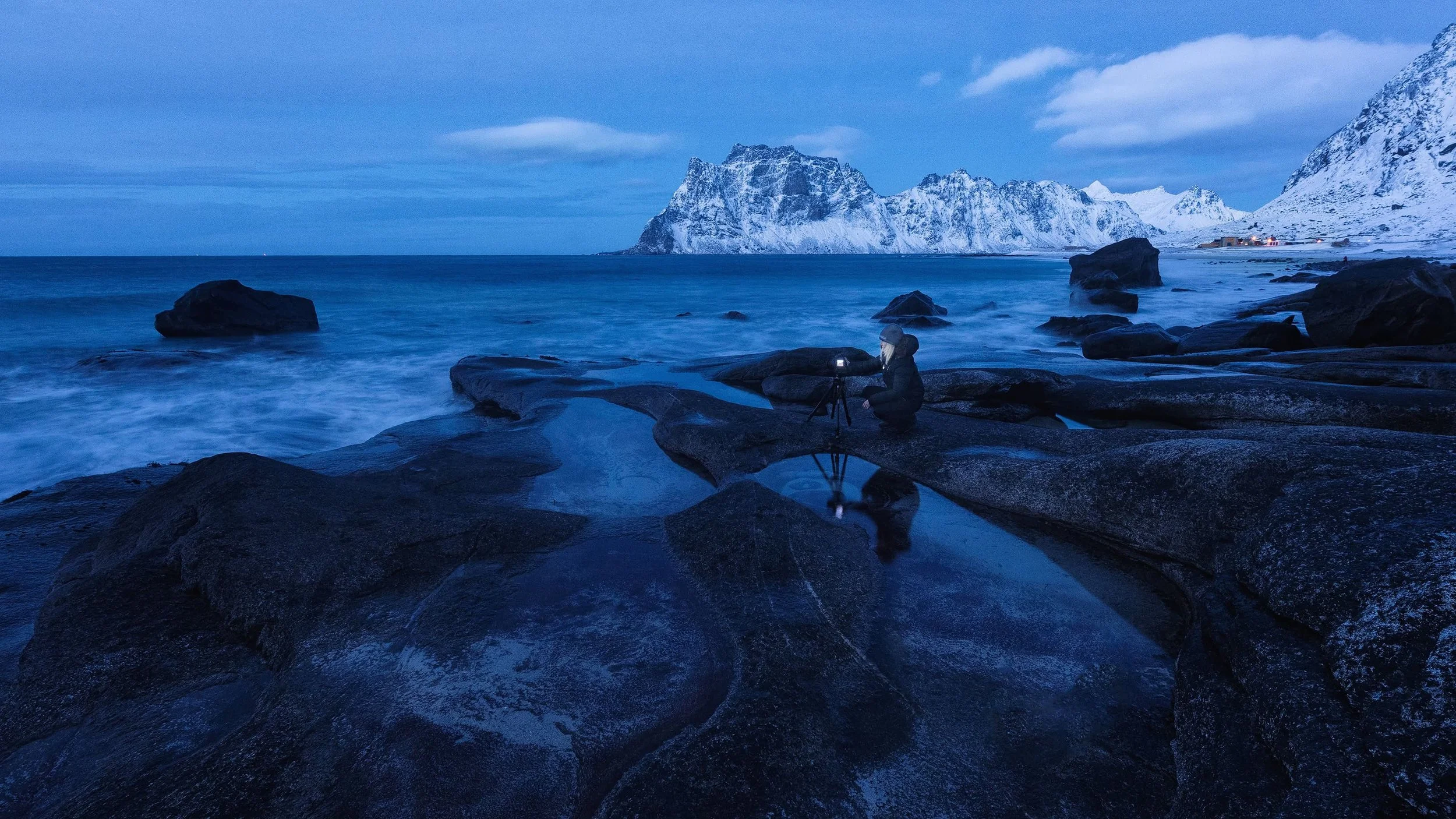
1) Uttakleiv Beach
Uttakleiv is one of the best winter beaches in Lofoten because it gives us options: wide-open views, dramatic weather, and strong foreground potential when conditions align. In winter it's often about embracing the mood — textured clouds, shifting light, the raw energy of the coast.
What we shoot here: foreground rocks, leading lines from the beach, wave motion, layered skies. Best light: late afternoon into sunset, and storm breaks with side light. Winter note: the wind can be intense. Keep it simple and stable — strong shapes, clean horizon, clear edges. Excellent for Aurora borealis. Lenses: 14–24mm / 16–35mm for immersive foreground; 24–70mm / 24–120mm for tighter framing; 70–200mm for isolating patterns and distant light.
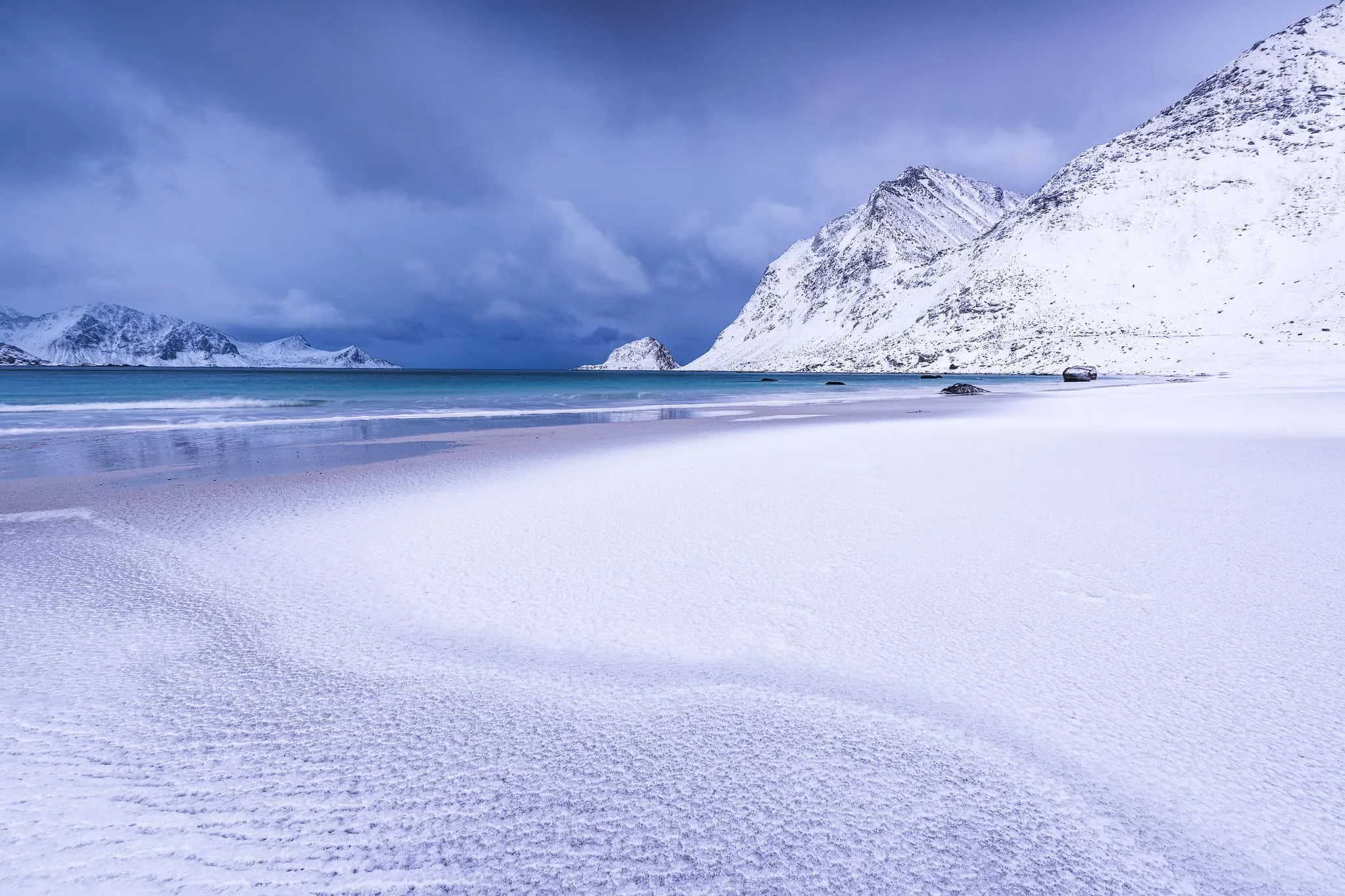
2) Haukland Beach
A winter classic for good reason: accessible, spacious, visually clean. When snow settles on the mountains and the beach stays open, you get strong contrast between bright landforms and darker water.
What we shoot here: mountain backdrop + clean beach foreground, minimal compositions, wide frames with depth. Best light: sunrise is great year-round; from late February you can shoot straight into the setting sun (rare). Winter note: watch your steps. Fresh snow makes it easy to ruin a gorgeous foreground by walking carelessly across it — be kind to yourself and others and avoid making a mess. Lenses: 14–24mm / 16–35mm; 24–70mm / 24–120mm; 70–200mm for compressing layers.
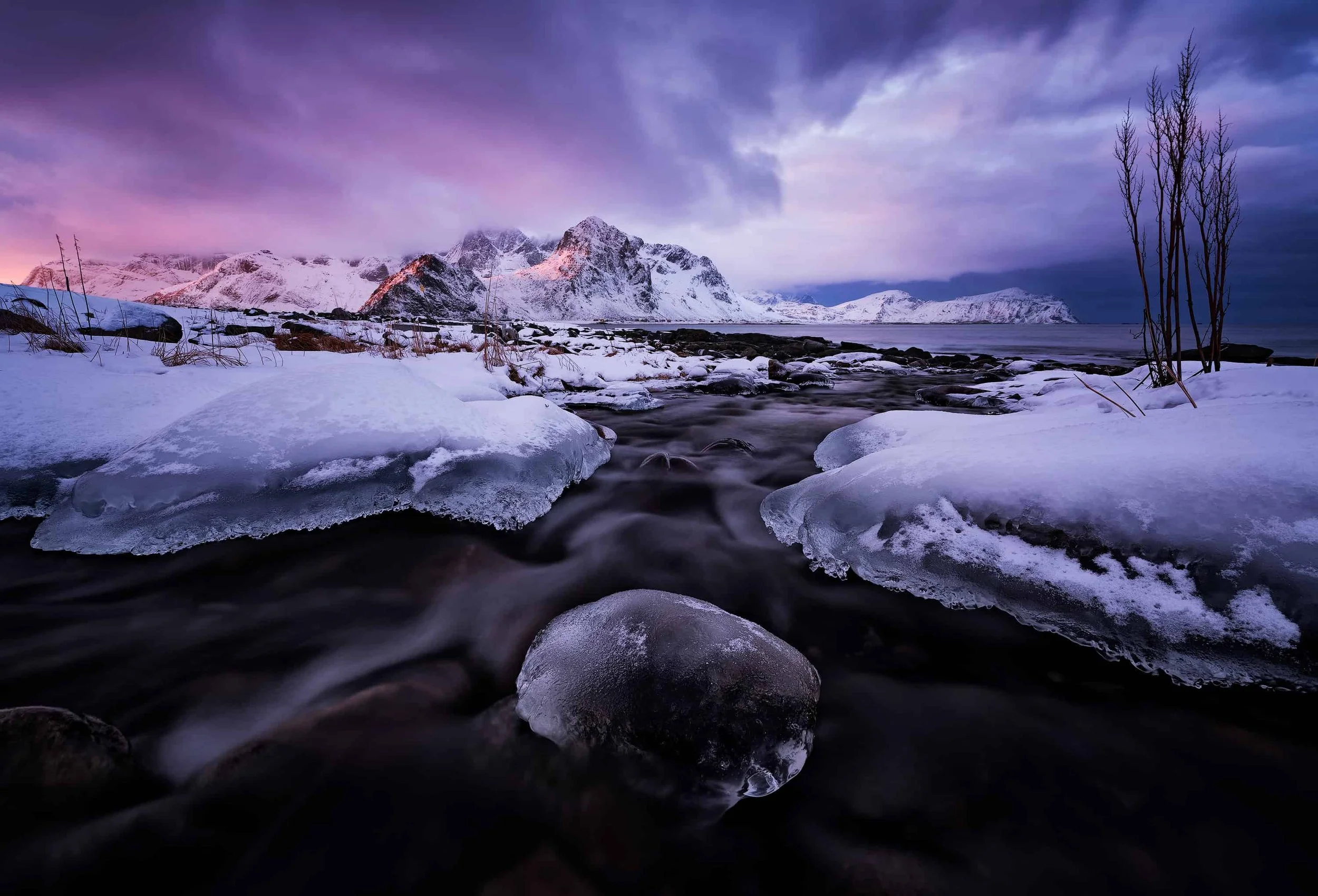
3) Vareid
A strong winter stop because it's visually interesting without a long hike or risky access. One of those places where the landscape feels graphic — clean shapes, lines, strong separation.
What we shoot here: dramatic seascapes, simplified coastal scenes, distant peaks, layered landforms. Best light: low sun angles, side light, moody overcast for minimalism. Winter note: watch how the light shines through the gap in the mountains. Check the tide and watch for sneaker waves — in stormy weather the sea is fierce here. Lenses: 24–70mm / 24–120mm; 70–200mm; 100–400mm to compress distant forms.
4) Unstad Beach
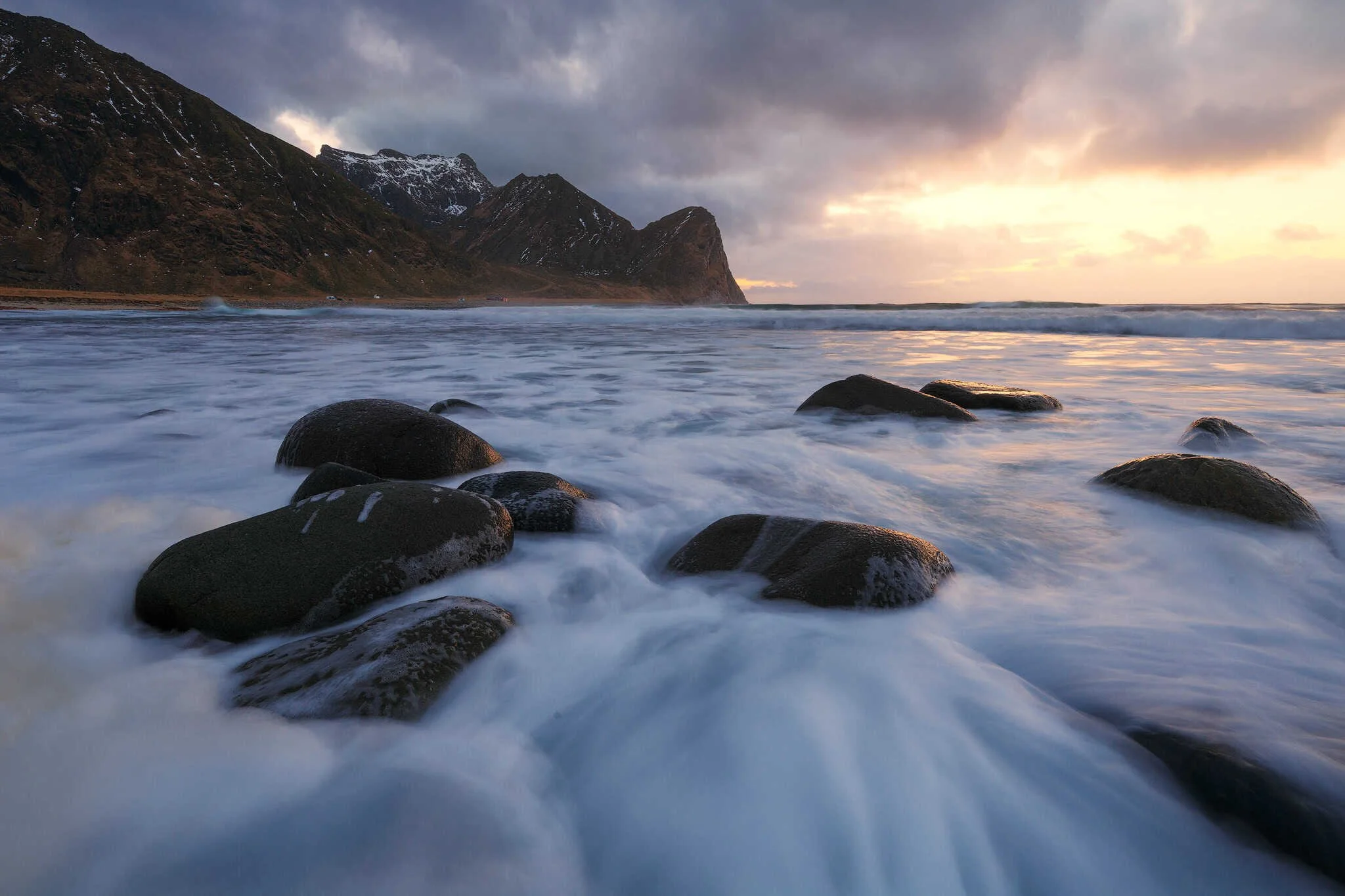
One of the most distinctive winter locations in Lofoten — wilder and more enclosed than the open beaches. The bay creates a natural frame, and the surrounding mountains give real depth when winter light shapes the layers. You'll often find surfers here, sometimes world-class ones.
What we shoot here: sweeping beach curves, strong foreground textures, surfers, wave motion, moody mountain backdrops. Best light: late afternoon into sunset, and storm breaks when light suddenly cuts through. Chance to shoot straight into the sunset from early March (rare). Winter note: keep the composition simple and let the weather make the mood. Use the shoreline as a leading line and watch your frame edges. Lenses: 14–24mm / 16–35mm for drama; 24–70mm / 24–120mm for cleaner framing; 70–200mm to compress the mountain layers.
5) Nusfjord
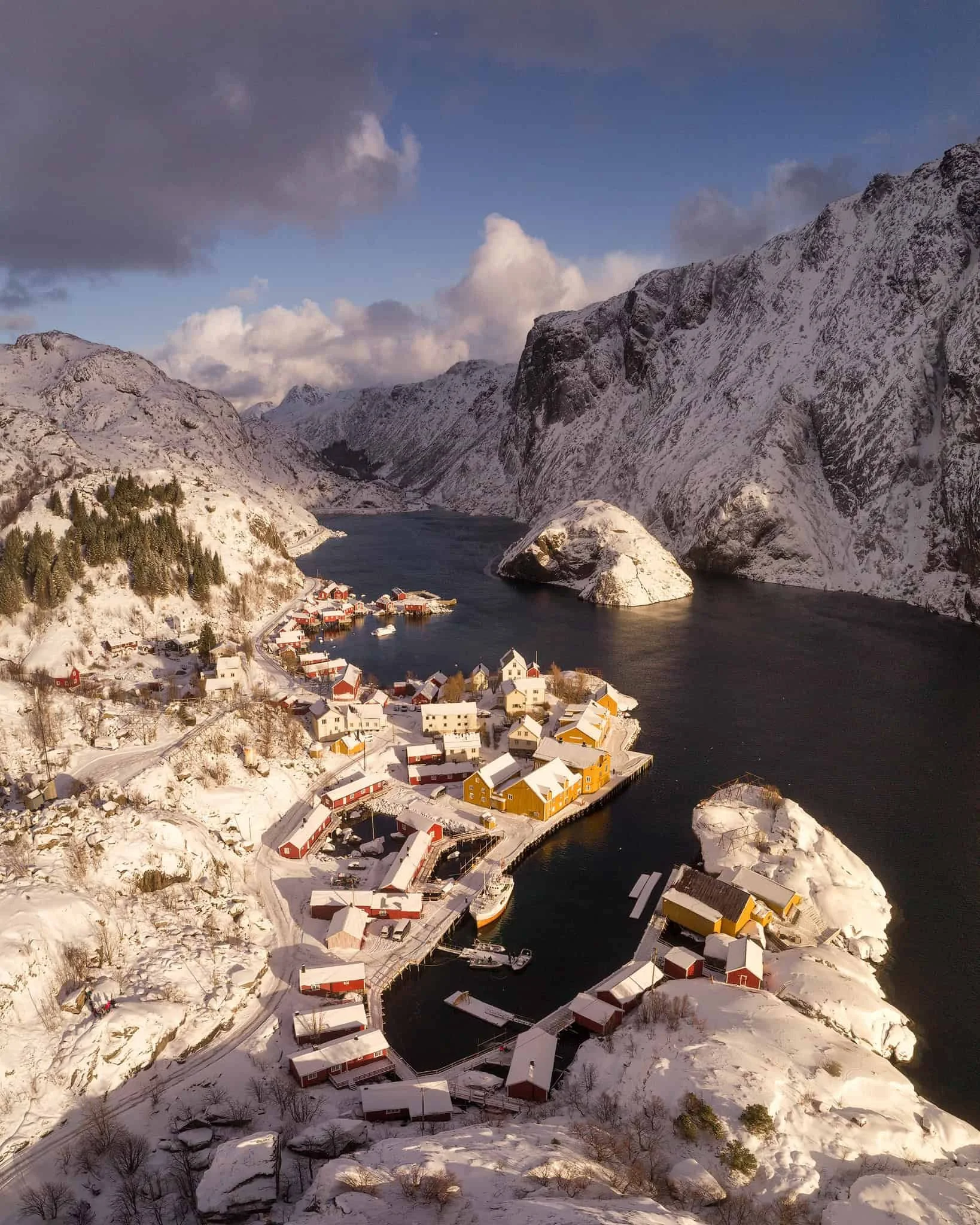
Winter-friendly because it offers something rare: structure and story. Not just mountains and sea, but the human scale of Lofoten framed by the landscape — and a UNESCO World Heritage site.
What we shoot here: village details, leading lines from docks, cabins against mountains, layered compositions. Best light: morning and blue hour, especially when the light is soft. Winter note: be respectful — people live and work here. Keep a low profile, don't block paths or entrances. There's an entry fee now, but also good parking and restaurants. Lenses: 16–35mm for environment; 24–70mm / 24–120mm for clean framing; 70–200mm for details.
6) Skagsanden Beach
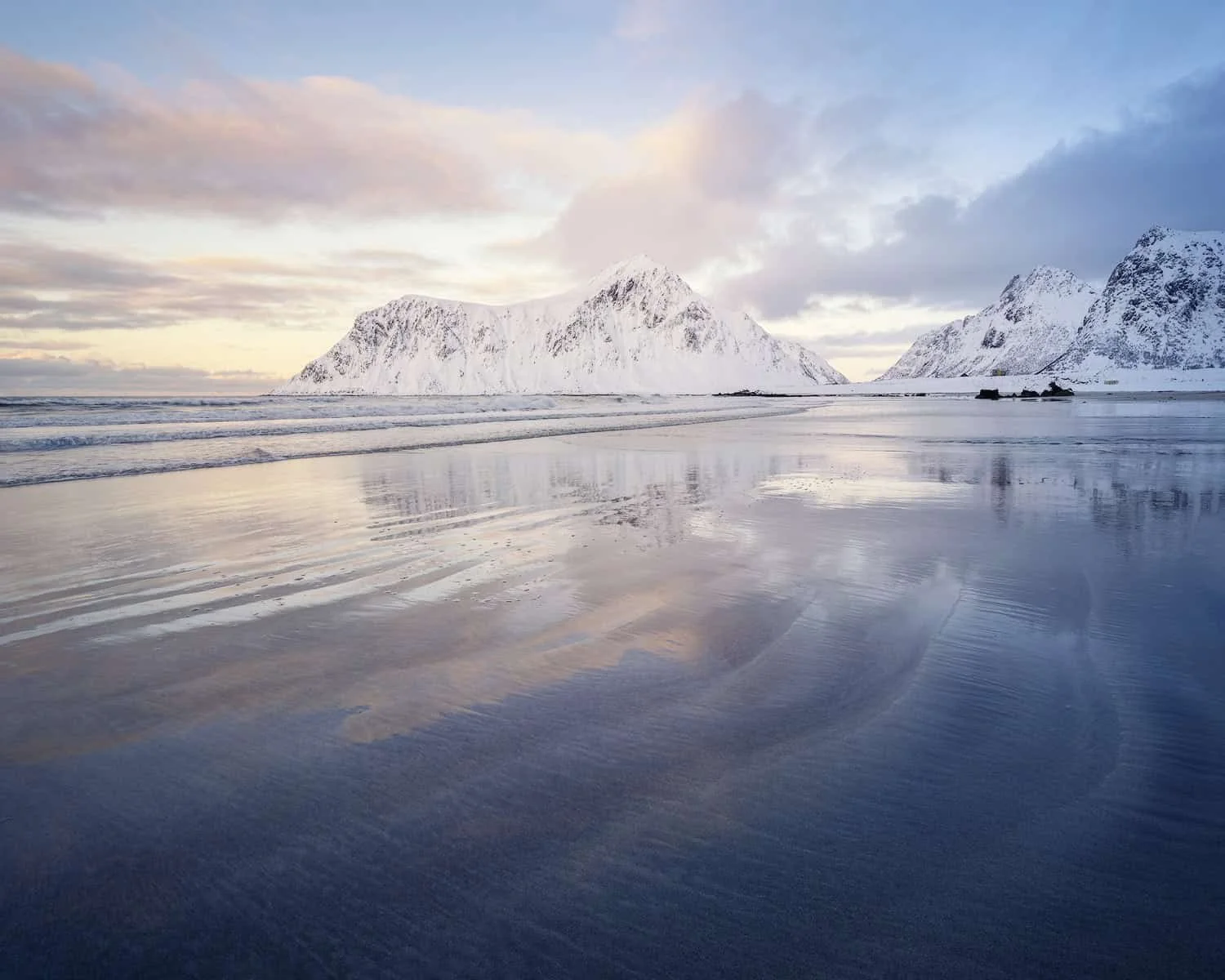
One of the most versatile winter beaches — it works in calm conditions and when the weather is wild, because the shapes are strong and the scene reads well even in flat light.
What we shoot here: shoreline curves, foreground sand textures, wave patterns, mountain layers. Best light: sunrise, sunset into blue hour, or any break in the clouds. Excellent for Aurora borealis. Winter note: focus on edge control — it's easy to let messy elements creep into the frame borders here. Lenses: 14–24mm / 16–35mm; 24–70mm / 24–120mm.
7) Fredvang Bridges
A strong "Lofoten postcard" feeling — bridges, water, peaks, layered depth. In winter it gets even more dramatic when snow highlights the shape of the mountains.
What we shoot here: bridge leading lines, compressed mountain layers, wide scenic frames, reflections. Best light: sunrise, sunset, blue hour. Winter note: parking and stopping behavior matters here. Never stop where you block traffic. There's an official parking spot now — pay the fee and go shoot. Lenses: 14–24mm; 24–70mm / 24–120mm; 70–200mm for compression.
8) Hamnøy
One of the most iconic winter scenes in Lofoten, and for good reason: the perfect mix of strong foreground structure, village elements, and towering peaks behind.
What we shoot here: classic bridge compositions, village + mountains, clean leading lines. Best light: sunrise and blue hour are the most consistent. Winter note: it gets busy even in winter. Work fast, stay aware of others, keep the scene clean in-camera. Park only in designated areas — or book a Rorbu cabin at Eliassen Rorbuer and just walk. Lenses: 16–35mm for the classic look; 24–70mm / 24–120mm for variations; 70–200mm for isolations.
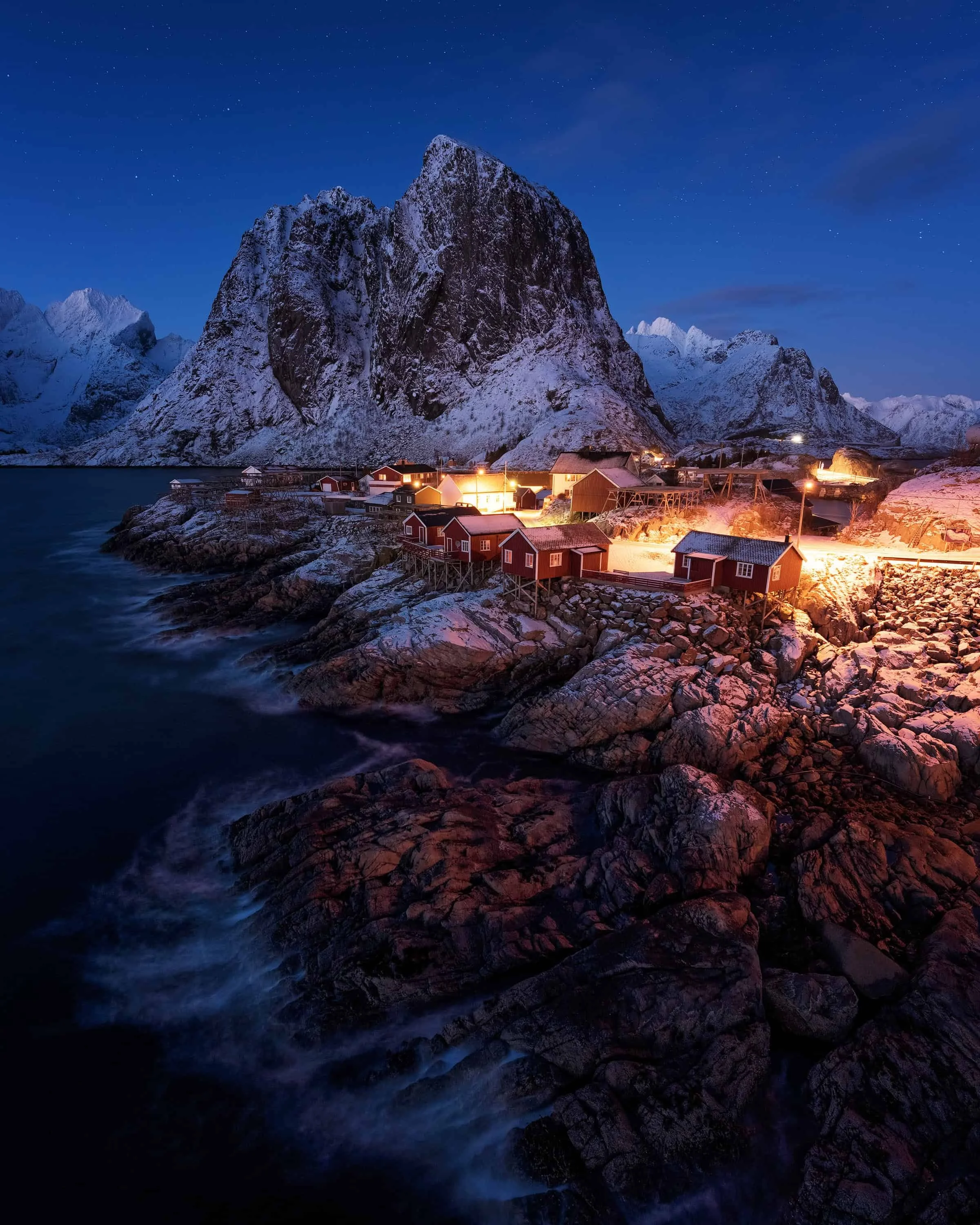
Hamnoy in Lofoten not only hosts the famous Eliassen Rorbuer- it´s also a great landscape photography location!
9) Sakrisøy
The perfect place to shoot winter color contrast: warm cabins, cool mountains, winter skies. Small changes in framing make a huge difference here.
What we shoot here: cabins as anchor subjects, mountain backdrops, minimal compositions. Best light: sunrise, sunset, and calm overcast for soft color. Winter note: don't force it. If the light is flat, go tighter and build clean compositions around one subject. Look around for a little hill to gain elevation — but never trespass on local property. Lenses: 24–70mm / 24–120mm; 70–200mm.
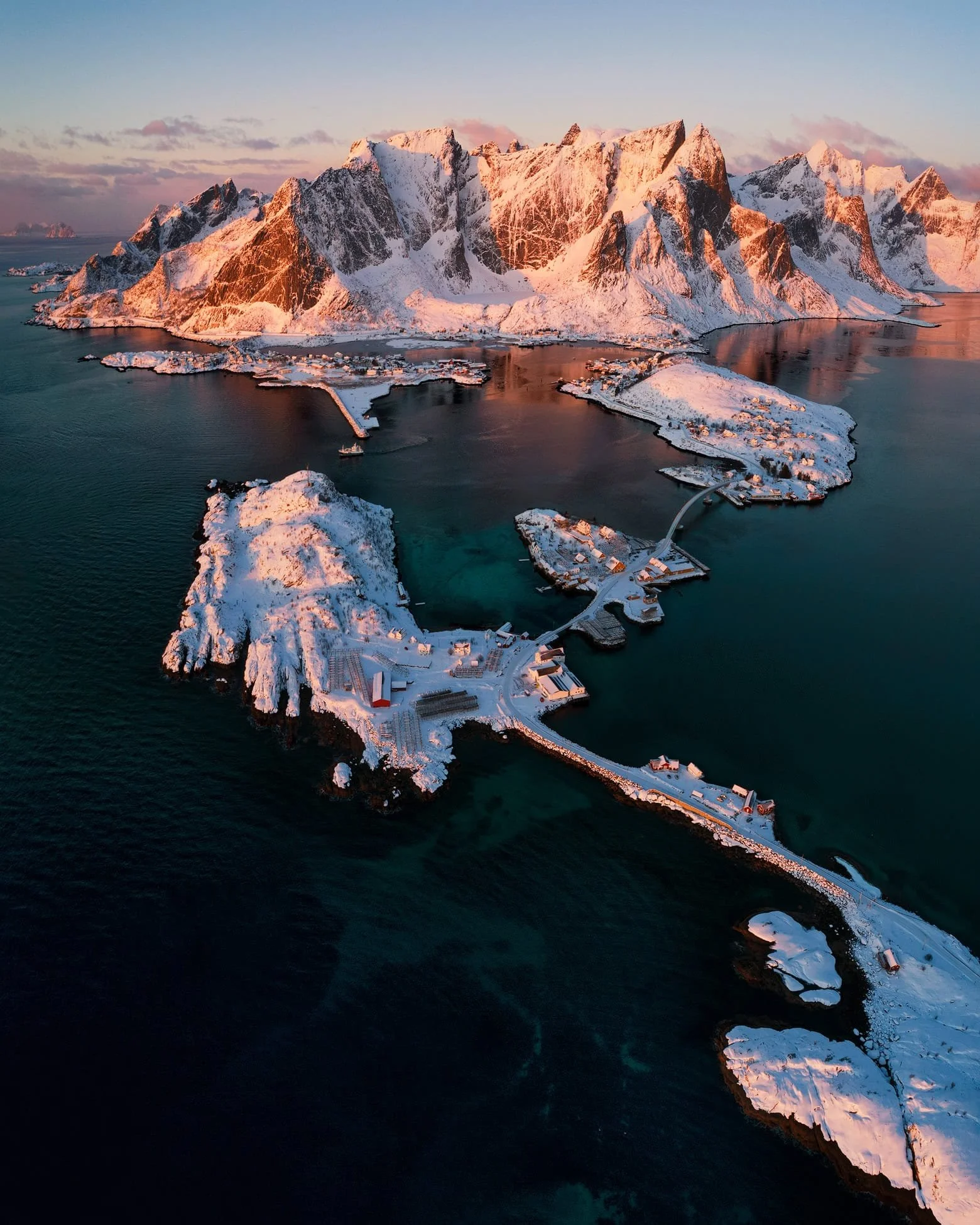
10) Reine
Not just a single viewpoint — a whole visual playground. Even in winter, when we can't access everything, there's plenty to work with: layers, peaks, reflections, village geometry, mood.
What we shoot here: layered fjord scenes, compressed mountain lines, quiet village details. Best light: sunrise, sunset, blue hour. Winter note: Reine rewards patience — the best frames often appear when the weather shifts and light starts carving depth into the landscape. Respect the drone rules and don't fly over the village. Lenses: 16–35mm; 24–70mm / 24–120mm; 70–200mm; 100–400mm for distant compression.
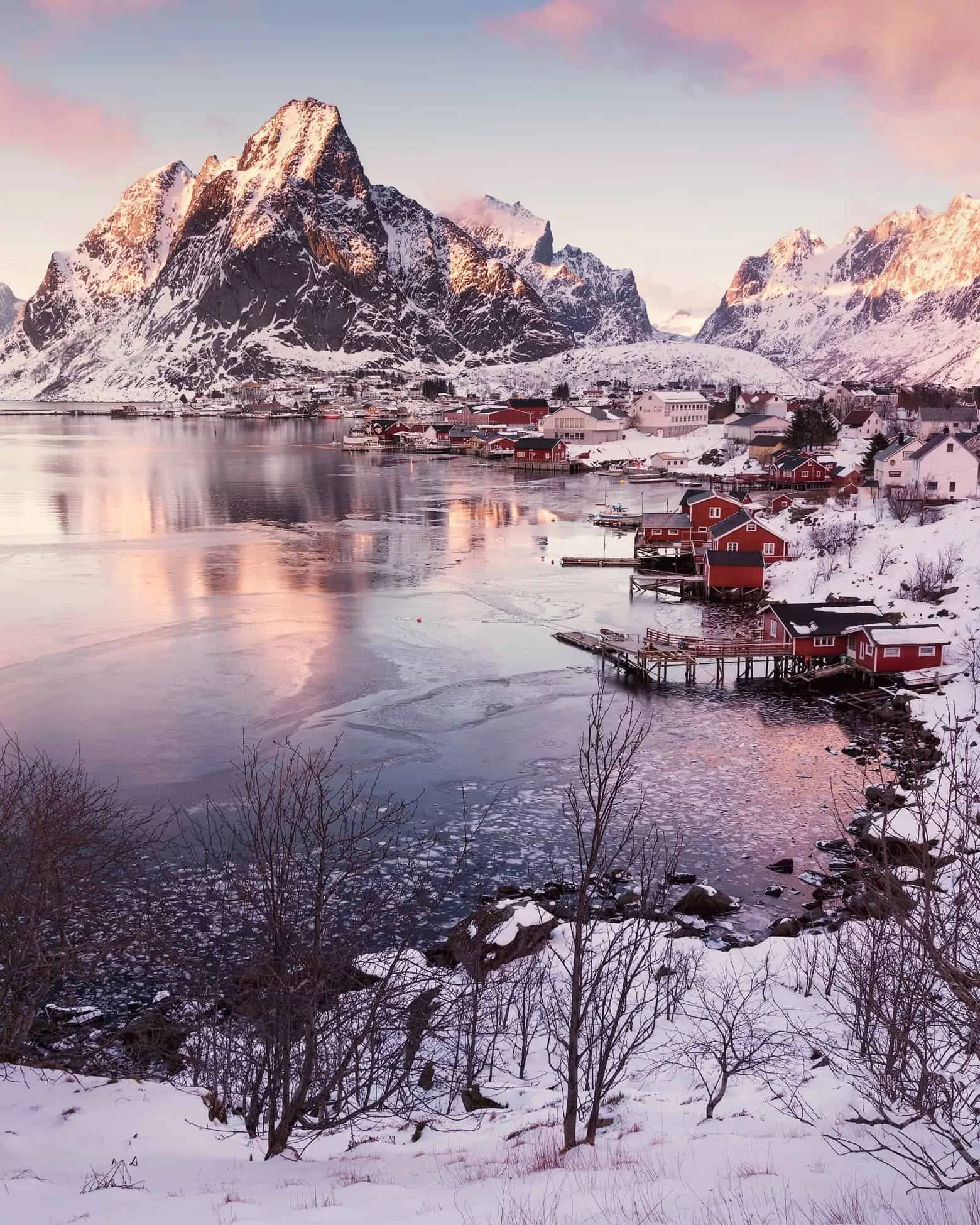
Reine i Lofoten islands is considered one of the most beautiful fisher towns in the whole world.
Tie-in: not sure which lenses to bring?
Check out my Guide about the Best lenses for Landscape Photography in 2026
Part 2 — How to actually pull off a Lofoten winter trip
Knowing where to shoot is half of it. The other half — the half that decides whether you go home with the images — is understanding what Lofoten in winter is really like. After every winter here since 2012, here's what I wish more people knew before they came.
Prepare for the worst weather you can imagine
Lofoten sits around 68° North — very high up — but it's also close to the Gulf Stream. That keeps winter temperatures relatively mild for the latitude, but it also makes the weather wildly unpredictable: cloudy, rainy, stormy. And clouds and rain don't exactly go hand in hand with the place everyone calls the perfect aurora base.
Realistically, you may have to endure wind, rain, hail, sleet and snowstorms to earn that famous winter light. Instead of looking like a winter paradise all season, Lofoten's weather makes full coast-to-peak snow coverage a relatively rare event — many visitors never see it at all. When the weather is bad, temperatures hover around 5°C with strong wind, and the precipitation falls as rain that washes the snow away, leaving the islands looking barren and muddy. Still beautiful — but not what you flew across the world for.
So bring the right clothing and prepare for cold, wet weather combined with strong wind. The windchill is what makes even 5°C feel brutal. But here's the positive flip side: that same fast-shifting weather is exactly what creates the extraordinary light. Those who endure a good storm get rewarded — one big snowstorm can transform the islands in hours: fresh snow from the ocean to the highest peak, temperatures dropping, fjords beginning to freeze, and then the sky suddenly clearing with aurora straight overhead. Those who endure are in for a treat.
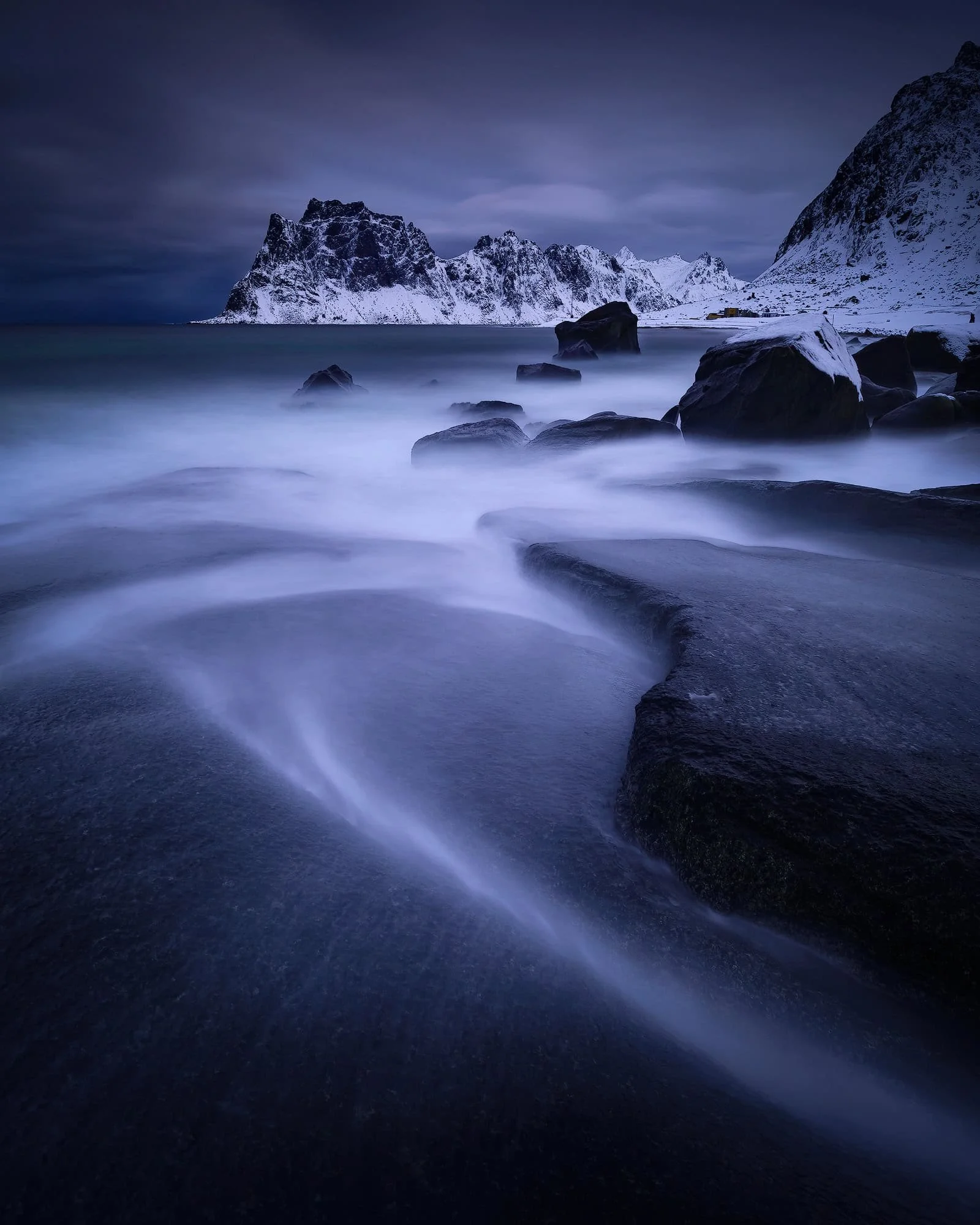
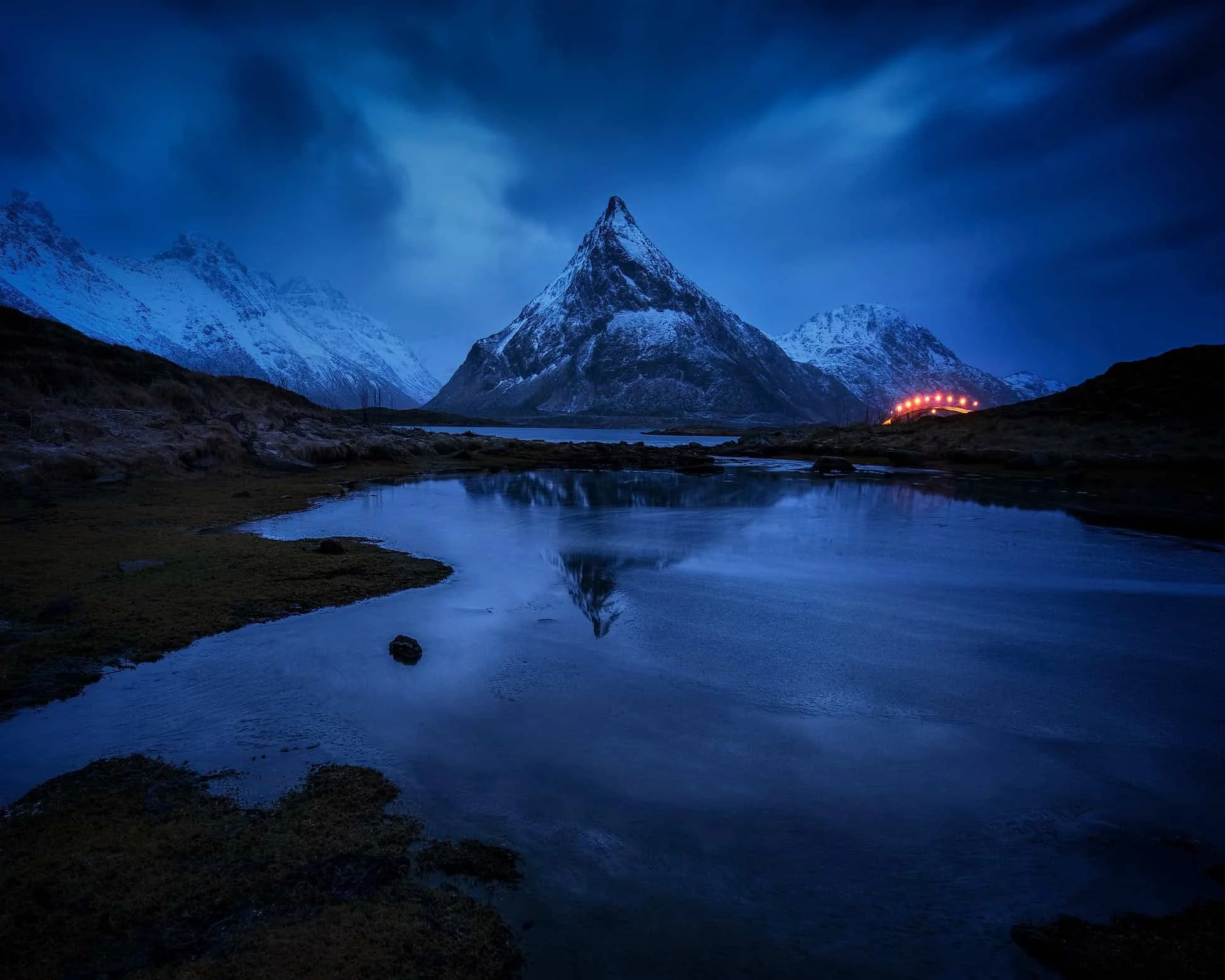
This image was shot in Uttakleiv in the pouring rain- be ready to battle the elements and moody landscape photography is the result!
Recommended winter clothing:
Merino long johns (400 weight)
Merino socks (400–800)
Insulated hiking pants
Hardshell rain pants to wear on top
Fleece jacket
A good down jacket (~800 fill power)
Waterproof hardshell jacket (Gore-Tex Pro)
Waterproof hiking boots or wellies
Photography gloves (Vallerret recommended)
Beanie and balaclava if you feel the cold in strong wind
Choose a well-located base
When I first started coming here, accommodation was scarce. Now there's huge variety — hotels, hostels, and the fantastic fishermen's cottages called Rorbuer. Back when people first settled Lofoten, the rorbuer were the only shelter fishermen had to rest after a long day at sea, or to wait out the storms passing through. I'm not against hotels in general, but for Lofoten I can only recommend a cosy Rorbu. Search "Rorbuer Lofoten" and you'll find many, in every price bracket from very basic to very stylish.
Keep location in mind when you book. I personally love staying around Ballstad — being based "in the middle" of Lofoten lets you adjust to the fast-shifting weather on the fly. Drive times range from about 20 minutes to the wonderful Haukland and Uttakleiv beaches, to roughly an hour down to Reine and Hamnøy. Shopping is easy in nearby Leknes, which also has an airport and car rental. And you don't even need to leave the area to find great photography and hiking — the Skottinden range right behind Ballstad is photogenic and great for hiking, so you can even sleep in and still get strong shots.
My personal choice has become the well-known Hattvika Lodge in Ballstad — simply the most cosy and well-cared-for Rorbu place on the islands. Run by the team around Kristian Bøe, you feel their passion in every design choice and the genuine hospitality of northern Norwegians. Beyond top-notch cabins, you get access to guided outdoor activities and one of the best restaurants for miles. There's even a glass-roofed sauna on the pier — and yes, a jacuzzi where you can watch the northern lights with your other half.
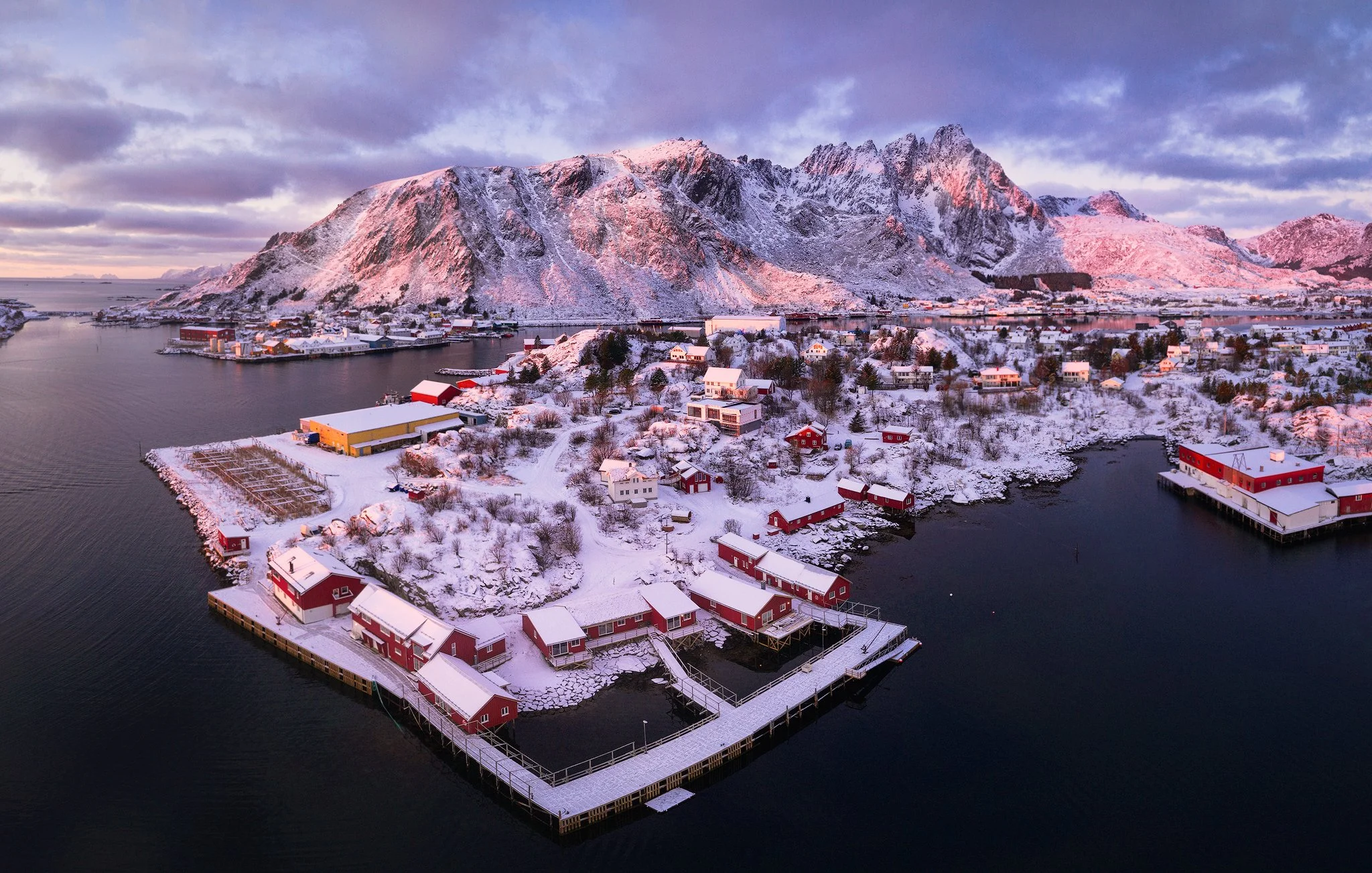
Hattvika Lodge in Ballstad is a fantastic place to stay!
Bring enough time to score good conditions
Don't plan a short trip. I understand Lofoten is expensive and your vacation time is precious — but if you're travelling across the world for winter landscapes, why not maximize your chances by staying as long as possible?
The weather changes fast, and if you only come for four days, that very often means four days of poor conditions and no aurora behind 100 km of cloud. I've seen it happen to many friends and photographers, and it hurts to watch them leave empty-handed. I've literally driven people to the airport after a rough week, only for a big snowstorm to transform the islands into a winter wonderland the day after they left.
So plan at least 7 days, ideally around 14 — that's my normal trip length, and with that approach I've had great aurora, beautiful light shows, and moody storm scenes on every single winter trip, including a 100% aurora score on the workshops I've guided. If you'd rather save yourself trouble and maximize the experience, look into local phototour operators — I recommend Lofoten Tours, and I'm one of their guides. But if you can only come for four days, come anyway. Everything is possible — especially on Lofoten.
Stay safe while driving (and don't be stupid)
This sounds blunt, but it matters. Every rental in northern Norway comes with studded tyres. The roads up here don't get cleared down to bare tarmac — instead the plowing teams compact the snow into a thick cap of ice that stays on the road most of the time. With studded tyres and cold conditions, driving on that ice is genuinely fine; the grip is great. It gets trickier as the weather warms, and the worst is rain and slush on frozen roads — you must slow down then, because it's very easy to slide off.
The car towing services up here are booked solid these days, largely because of tourists who ignore the road warnings and speed through narrow curves like they're racing. Don't be that person. Just drive slow, and never park in the middle of the road for a photo — everyone will thank you, especially the locals trying to get to work. Watch for the big trucks, which often move fast: signal, stay to the side, and let them pass. Do the same for locals. It's not worth risking your life over a rush — and the light lasts a long time in winter up here anyway.
Be flexible about the Aurora
I'll close with the single most important aurora tip: chase it when it's possible, sleep later.
I mentioned my 100% aurora score across all my personal and workshop trips over the years. That's true — but only because I constantly monitor the weather and solar activity. If we're lucky, the show fires up right after dark. But very often the solar wind arrives late, or the cloud layers only break deep in the night — hours when most people have given up and gone to bed. Those are the people who then complain about not seeing any aurora, while I photographed it during the very same window.
So if you really want that green glow in the night sky, be willing to skip a night's sleep. You can always sleep on the flight home.
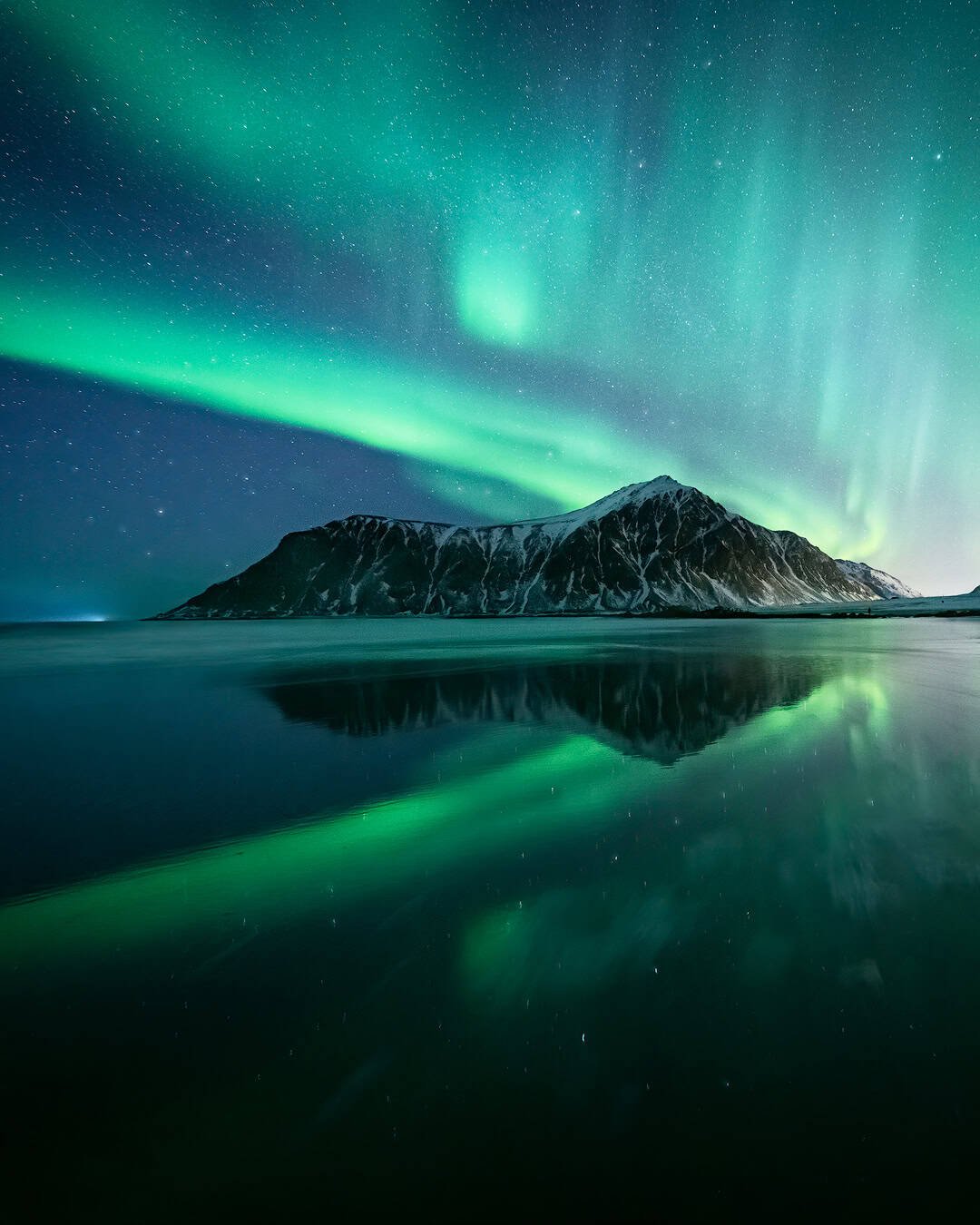
The Aurora boarelis also known as the northern lights seen from Skagsanden beach, Lofoten Islands in northern Norway
Want the full story on photographing the northern lights? Read my dedicated guide: how to photograph the Aurora borealis.
How to behave in Lofoten (so we don't ruin it)
This matters, and in winter it matters even more. Lofoten is not a theme park — people live here. They drive kids to school, deliver goods, and move through narrow roads in real winter conditions. A few rules make a massive difference:
Never stop in the road for a quick shot — even if it looks safe, even for ten seconds. It causes accidents. It has.
Don't park on snowbanks or block driveways. If there's no proper parking spot, the spot isn't worth it.
Don't climb fences or walk onto private property. A photo is never worth damaging land or stressing locals.
Keep noise and groups under control. Move efficiently, don't take over an area.
Leave no trace. No trash, no footprints through sensitive areas, no "just one step closer."
If we want Lofoten to stay accessible to photographers, this is the price of admission: respect.
Final thought: take your time, and watch
Winter light here can be incredible — but it's often subtle. The difference between a forgettable frame and a strong image usually comes down to a clean composition, strong edges, a clear subject, and committing at the right moment. That's true everywhere, but Lofoten rewards it especially.
Want a simple tool to get stronger compositions on the spot? Grab my free Field Method — the four checks I run before pressing the shutter on any landscape, including every frame in this guide. It's free, and I'll also send Postcards from the Wild, field stories from my expeditions.
Keep going
Planning the gear for a trip like this? See my camera guide and lens guide for landscape photography. For the night sky, how to photograph the Aurora borealis. Also check out my Faroe Islands Photography Guide for more nordic inspiration!
And if you'd like to shoot Lofoten with me, I guide winter trips here every year — get in touch.
Felix Inden is a landscape photographer and expedition leader based in Germany. PhotoPills Master. Multilingual guiding in German, English, and Spanish. He has photographed Lofoten every winter since 2012 and leads sold-out expeditions to Patagonia, the Faroe Islands, Lofoten, Iceland, and the Canadian Rockies.